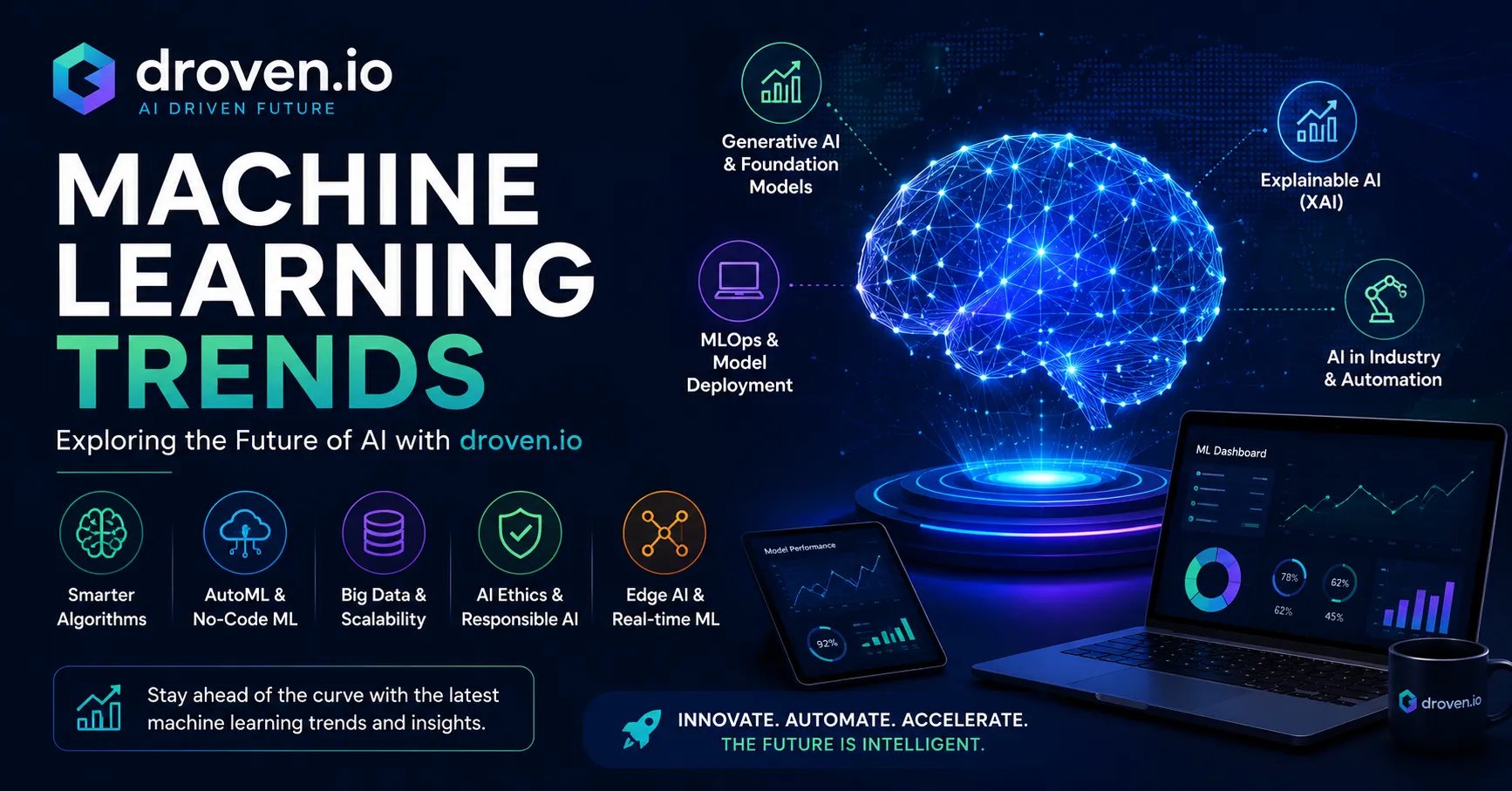
Machine learning is evolving rapidly, changing how businesses, developers, researchers, and everyday users interact with artificial intelligence. From generative AI and multimodal models to edge computing and automated machine learning, new technologies are creating opportunities across almost every industry. If you are researching droven.io machine learning trends, it is important to look beyond individual tools and understand the broader developments shaping the machine learning landscape. This guide explores the major trends worth watching, practical applications, benefits, challenges, and factors to consider before adopting a new ML technology. Rather than treating every emerging technology as a breakthrough, the focus is on understanding where machine learning is becoming more capable, efficient, accessible, and useful.
What Are Machine Learning Trends?
Machine learning trends are significant changes in the way AI and ML systems are developed, trained, deployed, and used. These trends can involve new model architectures, better training techniques, improved computing infrastructure, new business applications, or changes in how organizations manage AI systems.
Traditional machine learning typically focuses on tasks such as classification, regression, recommendation, and prediction. Modern ML increasingly combines these capabilities with large-scale models, natural language processing, computer vision, automation, and generative technologies.
Understanding these trends helps organizations determine which technologies are mature enough for practical use and which are still experimental.
Why Machine Learning Trends Matter
Following machine learning trends is useful because technology changes quickly. A technique that was expensive or difficult to implement a few years ago may become considerably more accessible as models, hardware, and development tools improve.
Businesses can use ML trends to identify opportunities for:
- Process automation
- Customer personalization
- Predictive analytics
- Fraud detection
- Recommendation systems
- Document processing
- Demand forecasting
- Computer vision
- Customer support
- Cybersecurity
- Operational optimization
However, adopting a trend simply because it is popular can create unnecessary costs. Organizations should connect machine learning investments to measurable business problems.
Droven.io Machine Learning Trends
The keyword droven.io machine learning trends can be used when researching information related to Droven.io and the broader machine learning ecosystem. When evaluating any specific website, platform, publication, or technology source, readers should distinguish between independently verified information and general industry commentary.
Machine learning trends are broader than any single website or platform. They include changes in model capabilities, AI infrastructure, data management, deployment strategies, and real-world adoption.
If you are using Droven.io as a source for ML-related information, evaluate the information based on factors such as:
- The original source of the information
- Publication or update date
- Technical evidence
- References to research or documentation
- Whether claims are independently verifiable
- Whether the information describes an established technology or an emerging experiment
This approach helps readers avoid confusing marketing claims with established machine learning developments.
Major Machine Learning Trends to Watch
1. Generative AI and Foundation Models
Generative AI has become one of the most visible areas of machine learning. Foundation models can be adapted to perform multiple tasks involving text, images, audio, video, and other forms of data.
Businesses are using generative AI for content assistance, software development, document analysis, customer service, research, and workflow automation.
The main challenge is reliability. Generative systems can produce incorrect information, making evaluation, human oversight, and appropriate application design important.
2. Multimodal Machine Learning
Multimodal AI combines different data types within a single system. Instead of processing only text or images, multimodal models can work with combinations such as text, images, audio, and video.
Potential applications include:
- Visual question answering
- Medical image analysis
- Document understanding
- Video analysis
- Accessibility tools
- Intelligent search
- Interactive AI assistants
As multimodal capabilities improve, AI systems can interact with information in ways that more closely resemble real-world workflows.
3. Smaller and More Efficient AI Models
Large models can require substantial computing resources. This has increased interest in smaller models that can deliver useful performance with lower infrastructure requirements.
Smaller models can be particularly valuable when organizations need:
- Lower operating costs
- Faster inference
- Greater privacy
- Local processing
- Offline functionality
- Edge deployment
Model efficiency is therefore becoming an important consideration alongside raw model capability.
4. AI Agents and Autonomous Workflows
Another developing area is AI systems that can perform multiple steps toward a goal rather than simply responding to a single prompt.
Agentic systems may interact with tools, retrieve information, execute workflows, and make decisions within predefined boundaries.
For businesses, potential applications include customer-support workflows, research assistance, software development, data processing, and administrative automation.
The major concern is control. Organizations need safeguards, permissions, monitoring, and clear boundaries for systems capable of taking actions.
5. Edge AI
Edge AI involves running machine learning models closer to where data is generated rather than relying entirely on centralized cloud infrastructure.
Examples include:
- Smart cameras
- Industrial equipment
- Mobile devices
- Automotive systems
- IoT devices
- Retail technology
Processing data locally can reduce latency and potentially improve privacy. However, edge devices often have limited computing power, storage, and energy resources.
6. Explainable AI
As machine learning becomes more influential in decision-making, understanding why a model produces a particular output becomes increasingly important.
Explainable AI techniques attempt to provide insight into model behavior and predictions.
This can be particularly important in areas where decisions have significant consequences, such as finance, healthcare, insurance, and compliance.
Explainability does not automatically make a model correct, but it can improve transparency and help teams identify unexpected behavior.
7. Responsible and Trustworthy AI
Machine learning development is increasingly concerned with responsible AI practices.
Important considerations include:
- Data privacy
- Security
- Bias
- Fairness
- Transparency
- Model reliability
- Human oversight
- Regulatory compliance
A technically impressive model may still create problems if it is trained on inappropriate data or deployed without sufficient safeguards.
8. Automated Machine Learning
Automated machine learning, commonly called AutoML, simplifies parts of the ML development process.
Depending on the platform, AutoML can assist with:
- Data preparation
- Feature selection
- Model selection
- Hyperparameter optimization
- Model evaluation
AutoML can reduce the technical barrier to machine learning, although expert oversight remains important for data quality, problem formulation, validation, and deployment.
9. Synthetic Data
Synthetic data is artificially generated data designed to resemble characteristics of real-world datasets.
It can be useful when real data is:
- Difficult to collect
- Expensive
- Limited
- Sensitive
- Subject to privacy restrictions
Synthetic data is not automatically equivalent to real data. Its usefulness depends on how accurately it represents the characteristics required for the intended ML task.
10. MLOps and Model Monitoring
Building a machine learning model is only part of the process. Organizations also need to deploy, monitor, update, and maintain models.
MLOps brings software engineering and operational practices into machine learning workflows.
Important areas include:
- Model versioning
- Data pipelines
- Testing
- Deployment
- Performance monitoring
- Drift detection
- Security
- Reproducibility
As ML adoption grows, reliable operational infrastructure becomes increasingly important.
Machine Learning Trends for Businesses
Businesses should evaluate machine learning trends from a practical perspective.
Instead of asking, “Which AI technology is most popular?”, a better question is:
“Which machine learning capability can solve a measurable problem for our organization?”
For example, an e-commerce company may benefit from recommendation systems or demand forecasting, while a manufacturing organization may prioritize predictive maintenance or computer vision.
A sensible evaluation process includes:
- Identify a specific business problem.
- Determine whether sufficient data exists.
- Establish measurable success criteria.
- Compare traditional solutions with ML.
- Estimate development and infrastructure costs.
- Test the technology with a limited pilot.
- Measure performance and business impact.
- Scale only after validating the results.
Machine Learning Trends for Developers
Developers following machine learning trends should pay attention not only to new models but also to the infrastructure surrounding them.
Important areas include:
- Model APIs
- Open-source models
- Vector databases
- Retrieval systems
- MLOps
- Model evaluation
- Data pipelines
- GPU and accelerator infrastructure
- Edge inference
- AI security
- Model optimization
Developers should also learn how to evaluate model outputs instead of assuming that a newer model is automatically better.
Benefits and Challenges
| Area | Potential Benefit | Main Challenge |
|---|---|---|
| Generative AI | Faster content and knowledge workflows | Accuracy and hallucinations |
| Multimodal AI | More flexible data processing | Higher complexity |
| Small models | Lower infrastructure requirements | Potential capability trade-offs |
| AI agents | Workflow automation | Control and reliability |
| Edge AI | Low latency and local processing | Hardware limitations |
| Explainable AI | Greater transparency | Explanations may be incomplete |
| AutoML | Faster model development | Requires quality data and validation |
| Synthetic data | Useful for limited datasets | May not accurately represent reality |
| MLOps | Reliable model operations | Infrastructure complexity |
How to Evaluate a New Machine Learning Trend
Step 1: Define the Problem
Start with the business or technical problem rather than the technology.
Step 2: Evaluate the Data
Check whether the available data is accurate, relevant, sufficiently large, and legally usable.
Step 3: Check Model Performance
Establish appropriate evaluation metrics before deploying the system.
Step 4: Estimate Implementation Cost
Consider development, computing, storage, monitoring, maintenance, and human-review costs.
Step 5: Assess Security and Privacy
Determine how sensitive data will be handled and whether the system introduces new security risks.
Step 6: Test Scalability
A model that works in a small experiment may behave differently at production scale.
Step 7: Monitor Results
After deployment, continuously evaluate model performance, data quality, errors, and changes in the environment.
Future of Machine Learning
The future of machine learning is likely to involve greater integration between models, software, data, and automated workflows.
Rather than treating AI as a standalone chatbot or prediction engine, organizations are increasingly exploring systems that can understand multiple types of information, use external tools, operate within defined workflows, and support complex decision-making.
At the same time, efficiency, security, privacy, evaluation, and governance will remain critical. The most useful machine learning technologies will not necessarily be those with the largest models or the most impressive demonstrations. Practical value will depend on reliability, cost, usability, and measurable outcomes.
Frequently Asked Questions
What does “droven.io machine learning trends” mean?
It refers to a search topic combining Droven.io with information about machine learning trends. Readers should verify specific claims about Droven.io against reliable, current sources.
What are the biggest machine learning trends?
Major areas include generative AI, multimodal models, efficient AI, AI agents, edge AI, AutoML, synthetic data, responsible AI, and MLOps.
Why should businesses follow machine learning trends?
Following trends can help businesses identify useful technologies and understand how AI may improve automation, forecasting, personalization, analytics, and operational efficiency.
Is every new ML trend worth adopting?
No. A technology should be evaluated according to its reliability, cost, security, data requirements, scalability, and ability to solve a genuine problem.
What is multimodal machine learning?
Multimodal machine learning works with multiple forms of information, such as text, images, audio, or video, rather than relying on a single data type.
What is MLOps?
MLOps refers to practices and infrastructure used to develop, deploy, monitor, maintain, and manage machine learning systems in production.
What is Edge AI?
Edge AI runs machine learning models closer to the device or location where data is generated, potentially reducing latency and dependence on cloud processing.
Will smaller machine learning models become more important?
Efficient models are likely to remain important because organizations often need lower costs, faster inference, privacy, and deployment on devices with limited resources.
How can I evaluate an AI trend?
Start by identifying the problem, evaluating available data, defining performance metrics, testing the technology, calculating costs, assessing risks, and measuring real-world results.
Conclusion
Understanding droven.io machine learning trends requires looking beyond individual technologies and considering the broader evolution of artificial intelligence and machine learning. Generative AI, multimodal systems, efficient models, AI agents, edge computing, AutoML, synthetic data, responsible AI, and MLOps are all important areas to watch.
The key is not simply to follow every new trend. Instead, organizations and developers should evaluate whether a technology is reliable, practical, secure, scalable, and capable of producing measurable value. By combining awareness of emerging developments with careful testing and responsible implementation, businesses can make better decisions about where machine learning fits into their future.