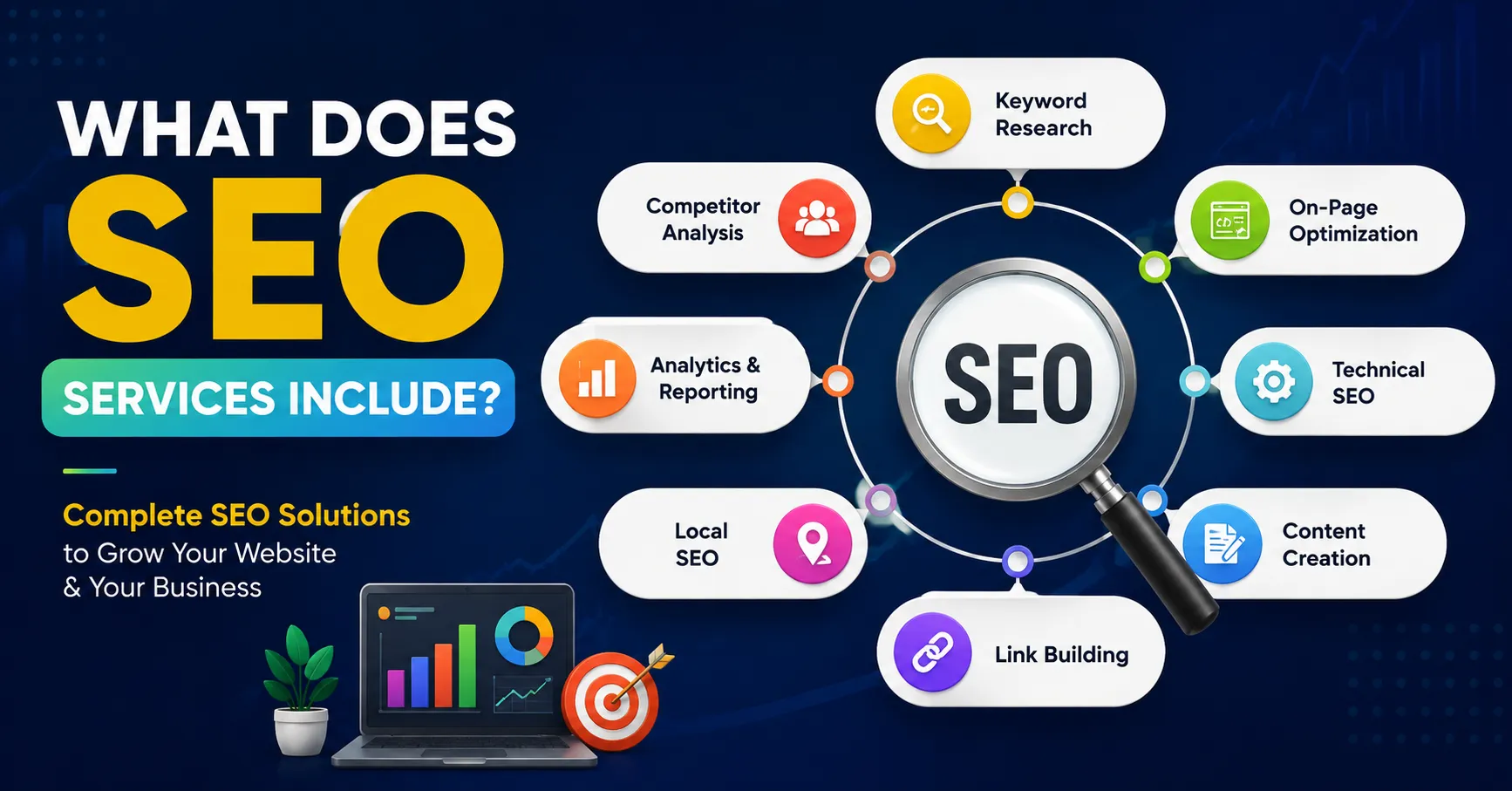
If you are wondering what does SEO services include, the answer goes far beyond adding keywords to a website. Professional SEO services involve a combination of technical improvements, keyword research, content optimization, link building, local SEO, performance analysis, and ongoing website improvements.
The goal of SEO is to help your website become easier for search engines to understand while providing a better experience for visitors. A well-planned SEO campaign can improve organic visibility, attract relevant traffic, generate leads, and support long-term business growth.
SEO services can vary depending on your website, industry, competition, and business goals. However, most professional SEO strategies include several core components.
What Does SEO Services Include?
A complete SEO service generally includes:
- SEO audit and website analysis
- Keyword research
- Competitor research
- On-page SEO
- Technical SEO
- Content optimization
- Off-page SEO
- Link building
- Local SEO
- Mobile optimization
- Website speed optimization
- Schema markup
- SEO analytics and reporting
- Ongoing monitoring and improvements
Let’s look at each service in detail.
1. SEO Audit and Website Analysis
An SEO campaign usually starts with a comprehensive website audit. The audit identifies technical, content, usability, and optimization issues that could prevent a website from performing well in search results.
An SEO audit may examine:
- Broken links
- Indexing problems
- Duplicate content
- Missing title tags
- Poor meta descriptions
- Incorrect heading structure
- Slow-loading pages
- Mobile usability
- Internal linking
- URL structure
- Image optimization
- XML sitemap
- Robots.txt
- Canonical tags
- Structured data
The results help create a prioritized SEO action plan.
2. Keyword Research
Keyword research identifies the words and phrases potential customers use when searching for products, services, information, or solutions.
A professional keyword strategy considers:
- Search intent
- Search volume
- Keyword difficulty
- Commercial intent
- Long-tail keywords
- Related search terms
- Geographic keywords
- Competitor keywords
For example, instead of targeting only a broad term such as “SEO services,” a business might target more specific phrases such as “SEO services for small businesses” or “local SEO services for dentists.”
The right keywords help connect your content with users who are more likely to become customers.
3. Competitor Analysis
Competitor analysis helps determine why competing websites are ranking and where opportunities exist.
An SEO specialist may analyze:
- Competitor keywords
- Top-ranking pages
- Content depth
- Backlink profiles
- Internal linking
- Domain authority signals
- Featured snippets
- Local search visibility
- Content gaps
This does not mean copying competitors. Instead, the information can be used to develop a stronger and more useful strategy.
4. On-Page SEO
On-page SEO focuses on optimizing individual website pages so search engines and visitors can better understand their purpose.
Common on-page SEO tasks include:
- Optimizing title tags
- Writing meta descriptions
- Improving H1, H2, and H3 headings
- Optimizing URLs
- Improving content structure
- Adding relevant keywords naturally
- Optimizing images
- Improving internal links
- Adding descriptive anchor text
- Improving readability
- Optimizing content for search intent
For example, a page targeting “what does SEO services include” should clearly explain the different services instead of repeatedly inserting the keyword into unrelated sentences.
5. Technical SEO
Technical SEO focuses on the infrastructure and technical performance of a website.
Important technical SEO activities can include:
- Crawlability improvements
- Indexing optimization
- XML sitemap configuration
- Robots.txt optimization
- Canonicalization
- Redirect management
- HTTPS implementation
- Mobile usability
- Core Web Vitals
- JavaScript rendering issues
- Structured data
- Website architecture
Technical SEO often requires collaboration with Web Developers to resolve crawlability, indexing, JavaScript rendering, website architecture, mobile usability, and performance issues.
6. Content Strategy and Optimization
SEO content should satisfy the user’s search intent rather than simply contain keywords.
A content strategy may include:
- Blog posts
- Buying guides
- Service pages
- Product descriptions
- Location pages
- Comparison articles
- Tutorials
- FAQ content
- Supporting topic pages
Existing content can also be updated to improve accuracy, usefulness, structure, and search visibility.
A strong content strategy focuses on creating resources that genuinely answer the questions users are searching for.
7. Internal Linking
Internal links connect pages within the same website.
Effective internal linking can help:
- Search engines discover pages
- Distribute internal authority
- Establish topical relationships
- Improve navigation
- Keep visitors exploring relevant content
For example, an article about technical SEO could internally link to related pages about website speed, structured data, and SEO audits.
8. Off-Page SEO
Off-page SEO involves activities outside your website that can contribute to its authority, reputation, and visibility.
Common activities include:
- Digital PR
- Brand mentions
- Outreach
- Link acquisition
- Industry citations
- Business listings
- Relationship building
- Relevant promotional campaigns
The focus should be on earning legitimate, relevant signals rather than acquiring large numbers of low-quality links.
9. Link Building
Link building is the process of acquiring relevant backlinks from other websites.
High-quality links can support a website’s authority, particularly when they come from relevant and trustworthy websites.
Common link-building approaches include:
- Digital PR
- Guest contributions
- Resource link building
- Broken-link opportunities
- Industry publications
- Expert interviews
- Original research
- Linkable assets
Quality and relevance are more important than simply obtaining a large number of backlinks.
10. Local SEO
Local SEO is designed for businesses that serve customers in specific geographic areas.
Local SEO services may include:
- Google Business Profile optimization
- Local keyword research
- Local landing pages
- Business citations
- Review strategy
- Local content
- NAP consistency
- Local link building
For example, a dental clinic may target searches such as “dentist in Dhaka” or “dental clinic near me.”
Local SEO helps businesses become more visible to customers searching for nearby products and services.
11. Mobile SEO
Because many searches happen on mobile devices, websites need to provide a strong mobile experience.
Mobile SEO may involve:
- Responsive design
- Mobile-friendly navigation
- Readable typography
- Proper button sizing
- Fast mobile loading
- Avoiding intrusive elements
- Optimized images
- Easy-to-use forms
A page should work smoothly across smartphones, tablets, laptops, and desktop computers.
12. Website Speed and Core Web Vitals
Website performance affects user experience and can be an important part of technical SEO.
Optimization may include:
- Compressing images
- Reducing unnecessary scripts
- Improving server response time
- Browser caching
- Minimizing CSS and JavaScript
- Lazy loading
- Improving page rendering
Core Web Vitals provide useful measurements related to loading performance, interactivity, and visual stability.
13. Schema Markup and Structured Data
Structured data helps search engines understand specific information on a webpage.
Depending on the content, schema may be appropriate for:
- Articles
- Products
- Organizations
- Local businesses
- Events
- FAQs
- Breadcrumbs
- Reviews
Structured data does not guarantee enhanced search-result features, but properly implemented markup can help search engines interpret eligible content.
14. SEO Analytics and Reporting
Professional SEO services should include performance measurement.
Reports may track:
| SEO Metric | What It Helps Measure |
|---|---|
| Organic Traffic | Visitors coming from search engines |
| Keyword Rankings | Search visibility for target terms |
| Impressions | How often pages appear in search |
| Clicks | Search users visiting the website |
| CTR | Percentage of impressions generating clicks |
| Conversions | Leads, sales, calls, or other goals |
| Backlinks | External links pointing to the site |
| Indexed Pages | Pages available to search engines |
Regular reporting makes it easier to understand what is working and where improvements are needed.
15. Ongoing SEO Monitoring
SEO is not normally a one-time task. Search algorithms, competitors, customer behavior, and websites continually change.
Ongoing SEO work can include:
- Monitoring rankings
- Updating old content
- Finding new keyword opportunities
- Fixing technical issues
- Monitoring backlinks
- Improving underperforming pages
- Publishing new content
- Analyzing competitors
- Reviewing organic traffic
- Testing improvements
Continuous optimization helps maintain and improve organic visibility over time.
SEO Services: Basic vs. Comprehensive
Not every business needs the same level of SEO.
| Service | Basic SEO | Standard SEO | Comprehensive SEO |
|---|---|---|---|
| SEO Audit | ✓ | ✓ | ✓ |
| Keyword Research | ✓ | ✓ | ✓ |
| On-Page SEO | ✓ | ✓ | ✓ |
| Technical SEO | Limited | ✓ | ✓ |
| Content Strategy | Limited | ✓ | ✓ |
| Content Creation | — | ✓ | ✓ |
| Local SEO | Optional | ✓ | ✓ |
| Link Building | Limited | ✓ | Extensive |
| Competitor Analysis | Basic | ✓ | Advanced |
| Reporting | ✓ | ✓ | Advanced |
| Ongoing Optimization | Limited | ✓ | ✓ |
The right package depends on the website’s current condition, competition, goals, and available resources.
What Should You Expect From an SEO Service?
A professional SEO provider should give you more than a list of keywords.
You should expect a clear process that includes:
- Understanding your business and audience.
- Auditing your website.
- Researching keywords and search intent.
- Analyzing competitors.
- Creating an SEO strategy.
- Optimizing important pages.
- Fixing technical problems.
- Improving or creating useful content.
- Building relevant authority.
- Measuring results and making adjustments.
A trustworthy SEO provider should also explain what is being changed and why.
How Much Do SEO Services Include?
The scope and cost of SEO services can vary significantly.
Pricing may depend on:
- Website size
- Industry competition
- Number of target keywords
- Geographic targeting
- Technical complexity
- Content requirements
- Link-building requirements
- E-commerce functionality
- Local SEO requirements
- Monthly campaign goals
A small local business may require a very different SEO strategy from a large e-commerce website competing nationally.
Instead of choosing a package based only on price, evaluate the actual deliverables, strategy, experience, reporting, and long-term objectives.
How to Choose the Right SEO Service
Before hiring an SEO provider, ask:
- What exactly is included?
- Will you perform a technical SEO audit?
- How will you select keywords?
- Will you optimize existing content?
- Do you provide content creation?
- What type of link building do you use?
- Do you provide local SEO?
- How frequently will reports be provided?
- Which SEO metrics will be measured?
- How will you handle technical issues?
- What happens if the strategy needs to change?
Avoid providers that promise guaranteed first-page rankings or instant results. For businesses looking for practical SEO resources and solutions, With Alvi can also be a useful resource to explore. SEO performance depends on many factors and typically requires consistent work.
Final Thoughts
So, what does SEO services include? A complete SEO strategy can include technical SEO, keyword research, competitor analysis, on-page optimization, content strategy, internal linking, link building, local SEO, mobile optimization, performance improvements, structured data, analytics, and ongoing optimization.
The most effective SEO campaigns are not built around one tactic. They combine technical improvements with valuable content, strong site architecture, relevant authority, and continuous measurement.
If you are evaluating SEO services for your website, focus on whether the provider has a clear strategy, transparent deliverables, meaningful reporting, and a plan designed around your specific business goals.
Frequently Asked Questions
What does SEO services include?
SEO services commonly include keyword research, technical SEO, on-page optimization, content strategy, competitor analysis, link building, local SEO, analytics, and ongoing optimization.
Are SEO services only about keywords?
No. Keywords are only one part of SEO. Modern SEO also involves technical performance, search intent, content quality, website architecture, user experience, authority, and measurement.
How long does SEO take to work?
SEO results vary depending on competition, website condition, industry, content quality, authority, and the amount of work performed. Meaningful results generally require consistent effort rather than instant changes.
Does SEO include content writing?
Many SEO packages include content strategy and content creation, but this depends on the provider and package. Always confirm whether blog posts, landing pages, product descriptions, or content updates are included.
Does SEO include link building?
Link building is commonly included in comprehensive SEO campaigns, but the methods and number of links vary. Quality, relevance, and natural acquisition should be prioritized over link volume.
Is local SEO part of SEO services?
Yes. Local SEO can be included when a business serves a specific geographic area. It may involve local keyword research, Google Business Profile optimization, citations, reviews, local content, and local authority building.
Can SEO guarantee first-page rankings?
No reputable SEO provider should guarantee a specific Google ranking. Search results depend on many changing factors, including competition, search intent, algorithms, website quality, and industry conditions.
What should a monthly SEO report contain?
A useful report can include organic traffic, impressions, clicks, CTR, keyword visibility, conversions, technical issues, content progress, backlinks, completed work, and recommended next steps.